
The modern trend of rejecting the Abhidhamma and the commentaries.
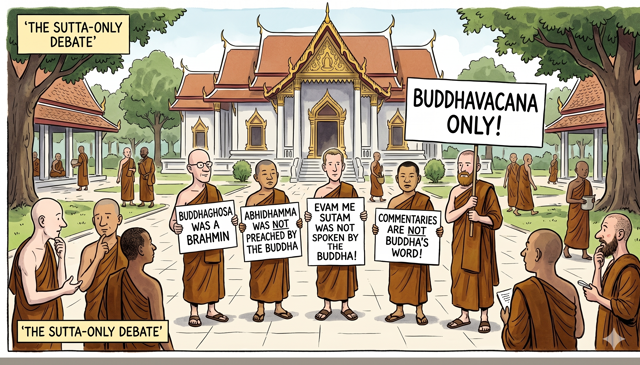
The modern trend of rejecting the Abhidhamma and the commentaries to rely solely on the suttas is not a new phenomenon. It is a repetition of a historical error that ultimately fragmented the teachings and gave rise to Mahāyāna philosophies.
Centuries after the Buddha’s Parinibbāna, a prominent early school known as the Sarvāstivāda developed a massive and highly complex Abhidharma system. In reaction to the perceived over-complication of the Sarvāstivādin Abhidharma, a splinter group emerged. They called themselves the Sautrāntikas—literally meaning “those who rely upon the sūtras.”
The Sautrāntikas famously rejected the Abhidharma entirely, declaring that only the sūtras were the valid words of the Buddha. While this “sūtra-only” approach may have sounded pure in theory, it created a massive philosophical vacuum. The sūtras frequently use conventional language and metaphor. Without the precise, ultimate framework (paramattha) of the Abhidharma to anchor their meaning, the Sautrāntikas found themselves unable to explain complex doctrinal issues, such as how kamma passes from one life to the next without a permanent soul.
To solve the problems created by their rejection of the Abhidharma, the Sautrāntikas had to invent new theories. They developed the concept of “seeds” (bīja) of kamma that are planted in a subtle consciousness.
The Birth of Mahāyāna and Vajrayāna: This “sūtra-only” deviation was the direct stepping stone to later Mahāyāna developments. The philosophical school known as Yogācāra (the “Mind-Only” school) took the Sautrāntika theory of karmic seeds and expanded it into the ālaya-vijñāna (the “storehouse consciousness”). Yogācāra philosophy, alongside the emptiness doctrines of Madhyamaka, became the core philosophical engine of the Mahāyāna vehicle. Over centuries, these Mahāyāna concepts absorbed esoteric and tantric practices, eventually evolving into Vajrayāna (Tibetan Buddhism).
The Lesson for Today: History provides a clear warning. When the Sautrāntikas rejected the Abhidharma and the established commentaries in favor of a “sūtra-only” approach, they did not return to a “pure” original Buddhism. Instead, they destroyed the analytical framework necessary to understand the suttas properly, forcing them to invent new philosophies that ultimately morphed into Mahāyāna and Vajrayāna.
Today’s modern “Sutta-only” and “EBT” movements risk making the exact same error. By discarding the Theravāda Abhidhamma and the Aṭṭhakathā, they untether the suttas from their traditional moorings. Orthodox Theravāda preserves the Abhidhamma and the commentaries precisely to prevent this kind of doctrinal drift, ensuring that the Dhamma we practice today is the exact same Dhamma preserved by the Arahants of old.